The True Cost of Manual Aircraft Scheduling Software


The phone rings at the desk. A renter wants the 172 on Saturday morning. Someone flips through the binder, squints at the whiteboard, says it looks open, and writes the name in.
What the whiteboard does not say is that the owner promised that same block to a student two days ago from his cell phone, and that the plane is due to come out of its 100-hour on Friday, maybe.
Nothing about this feels expensive. The whiteboard cost twelve dollars. The spreadsheet is free. The group text costs nothing at all. That is exactly why manual scheduling survives at so many operations long after it stops working: the price never shows up on an invoice.
But it does show up. It shows up as an airplane that sits when it could be flying, a renter who quietly moves to the school across the field, and hours of somebody's week spent playing phone tag. Here is what the "free" system actually costs, with real numbers you can check against your own operation.
Cost #1: The empty airplane hour
An airplane only earns when it flies. The median wet rental rate for a Cessna 172 in the United States is now $176 per hour, based on a 2026 survey of roughly 1,600 rental aircraft, and most fall between $150 and $210.
Manual scheduling leaks flyable hours in a very specific way. Someone books the popular Saturday slot, cancels Thursday night, and the slot dies. Nobody else knew it opened, because the only people who could have refilled it would have needed to call and ask. On a whiteboard, a freed-up hour is invisible.
Run the conservative math. One unfilled hour per week, at the median rate, is about $9,150 a year, per airplane. If you run three aircraft and each leaks two hours a week, you are leaving over $50,000 of flying on the table annually. Not because demand is missing. Because nobody could see the opening.
Cost #2: The double-booking
Two renters show up for the same airplane at the same time. One of them flies. The other one stands on the ramp deciding how they feel about your operation.
The direct cost of a double-booking is one lost rental. The real cost is what happens after. A renter who gets burned once starts calling ahead to confirm, which doubles your phone traffic. A renter who gets burned twice starts renting somewhere else, and a regular renter flying 50 hours a year at $176 is an $8,800 annual customer. A student who keeps losing booked lessons to scheduling mix-ups does not just cost you a lesson. Students talk, and word of mouth is how small operations live or die.
Double-bookings on a manual system are not a discipline problem. They are a design problem. Any schedule that two people can write on independently, from two different places, will eventually book the same hour twice. It is a matter of when, not if.
Cost #3: Phone tag as a booking system
When the schedule lives on a whiteboard or in one person's spreadsheet, every booking requires a conversation. Call, ask what is open, wait for someone to check, pick a slot, hope it was written down.
Say a modest operation handles 80 bookings a month, and each one takes ten minutes of somebody's time between the calls, the callbacks, and the writing down. That is more than 13 hours a month of staff time spent being a human calendar. At even $20 an hour, that is over $3,200 a year to do a job software does instantly, and it is usually your front desk person or an owner doing it, someone whose time had better uses.
There is a quieter cost here too. Every booking that requires a phone call during business hours is a booking that cannot happen at 9 pm on a Tuesday, which is exactly when a renter is sitting on the couch deciding whether to fly this weekend. Operations that only take bookings by phone are closed at the moment most decisions to fly get made.
Cost #4: The one person who holds the schedule
In almost every manually scheduled operation there is one person who really runs it. They know the pencil markings, they remember who called, they know the 152 is spoken for on Sundays. The system works because it lives in their head.
Then they take a vacation, or get sick, or move on, and the operation discovers the schedule was never actually written anywhere. Rebuilding that knowledge costs weeks of confusion and a handful of the double-bookings from Cost #2. A schedule that depends on one specific human being present is not a system. It is a single point of failure with a desk.
Cost #5: The maintenance surprise
The 100-hour ran long. The annual started Monday. On a whiteboard, maintenance lives in a different conversation from bookings, so renters keep reserving an airplane that is sitting in the shop with its cowling off. Every one of those bookings becomes an apologetic phone call, a scramble to move someone to another aircraft, or a customer who drove to the airport for nothing.
The cost is partly the lost rental, but mostly the pattern. An operation that regularly cancels on customers trains those customers to have a backup plan, and eventually the backup plan becomes the plan.
Add it up for your own operation
You do not have to take the example numbers. Three figures tell you what manual scheduling costs you specifically:
Leaked hours: unfilled cancellations per week × your hourly rate × 52.
Admin time: bookings per month × minutes per booking, divided by 60, × what an hour of that person's time is worth × 12.
Lost customers: one regular renter or student who leaves per year × their annual value.
For most small operations that honest tally lands somewhere between $10,000 and $60,000 a year. Against that, the cost of fixing it barely registers.
How Much Does Aircraft Scheduling Software Cost?
This is the part that surprises people. Aircraft scheduling software is one of the cheapest line items in aviation.
Some platforms price per aircraft per month and bundle in billing engines, which makes sense for larger flight schools that want all of it. PilotSchedule deliberately keeps it simpler and flat: the Solo plan is $19 a month, the Basic plan is $49.99 a month for up to five aircraft or resources, with no setup fee, no contract, and published pricing you can read without requesting a quote. See the plans page for current pricing.
Put that against the math above. If one live calendar recovers a single flyable hour a month, the software has paid for itself several times over. Everything past that first hour is money the whiteboard was quietly losing.
What changes on day one
Move the schedule online and each of the five costs gets addressed directly:
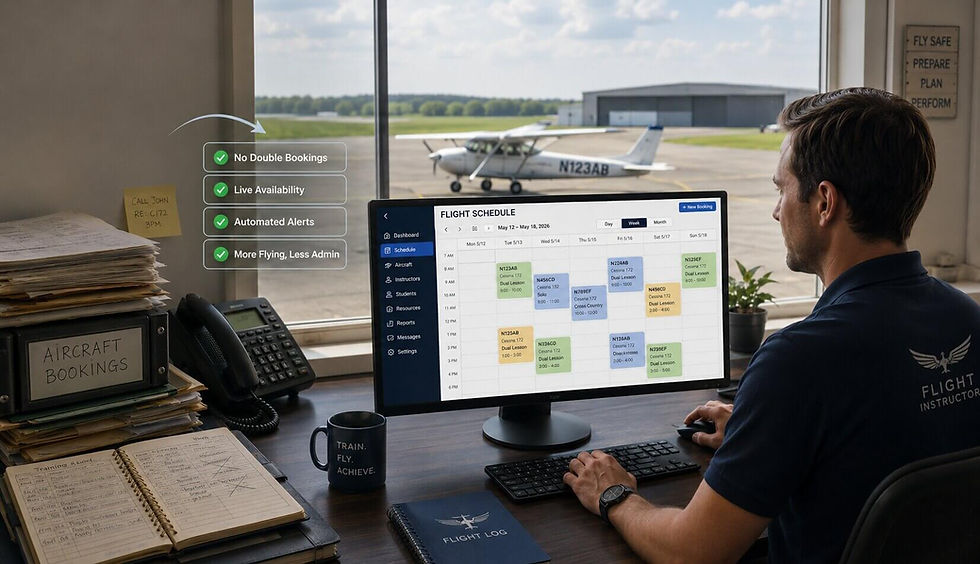
One live calendar everyone sees in real time, from a phone or a laptop, with day, pilot, and resource views. A freed-up Saturday is visible the moment it opens, and a backup reservation puts the next pilot in line and emails them when the slot becomes theirs.
No double-bookings, because the calendar simply will not take two reservations for the same aircraft at the same hour.
Self-service booking, so renters and students book at 9 pm on Tuesday without calling anyone, and your desk stops being a human calendar.
A schedule log, so there is a record of who booked what and nothing lives in one person's head. The schedule is the system, and anyone can see it.
Maintenance blocking, so when the annual starts, you block the airplane once and every renter sees it instantly.
More than airplanes. Instructors and custom resources (a simulator, a hangar bay, a tow tractor) live on the same calendar, and mass email reaches every pilot at once when plans change.
Setup is an afternoon, not a project: create an account, add your aircraft, invite your people, and start booking. PilotSchedule has been doing exactly this job, built by a pilot, since 2003.
Frequently asked questions
Is a whiteboard or spreadsheet ever enough?
For a single owner with one airplane and no renters, sure. The costs in this article start the moment more than a couple of people can claim the same aircraft, which is when unseen cancellations, double-bookings, and phone tag begin compounding.
How much revenue does an unfilled aircraft hour really cost?
Whatever your wet rate is. The 2026 national median for a Cessna 172 is about $176 an hour, so one leaked hour a week is roughly $9,150 a year per airplane. Twins, complex aircraft, and busy markets lose more.
What does aircraft scheduling software cost?
PilotSchedule is flat and published: $19 a month for the Solo plan and $49.99 a month for the Basic plan with up to five aircraft or resources, no contract and no setup fee. Per-aircraft platforms with billing bundled typically run $8 to $12 per aircraft per month and up.
Does PilotSchedule handle billing or accounting?
No, on purpose. PilotSchedule keeps to scheduling, which is why it stays simple and affordable. Most small operations and groups handle money their own way and just want the schedule fixed. If you need invoicing inside the same system, a per-aircraft platform that bundles billing will fit better.
Do renters and students actually use online booking?
Yes, and they prefer it. Most bookings happen outside business hours once self-service is available. The people most resistant to change are usually behind the desk, not in the airplane, and the desk is who the software relieves first.
How long does it take to switch from a manual system?
An afternoon. Add aircraft, set your hours and rules, invite members and renters, and block any maintenance dates. Most operations run the whiteboard and the calendar in parallel for a week or two, then quietly retire the whiteboard.
The bottom line
Manual scheduling is not free. It just sends the bill in ways that are easy to miss: empty flyable hours, burned renters, phone tag, and a schedule that lives in one person's head. Added up honestly, the whiteboard is one of the most expensive pieces of equipment at the airport.
PilotSchedule is built for exactly this corner of aviation: small operations, flying clubs, partnerships, and groups that share aircraft, not enterprise flight departments. The fix costs less per month than one hour of 172 time. If you are ready to see what your schedule looks like when it runs itself, create your free account and have your aircraft bookable this afternoon.