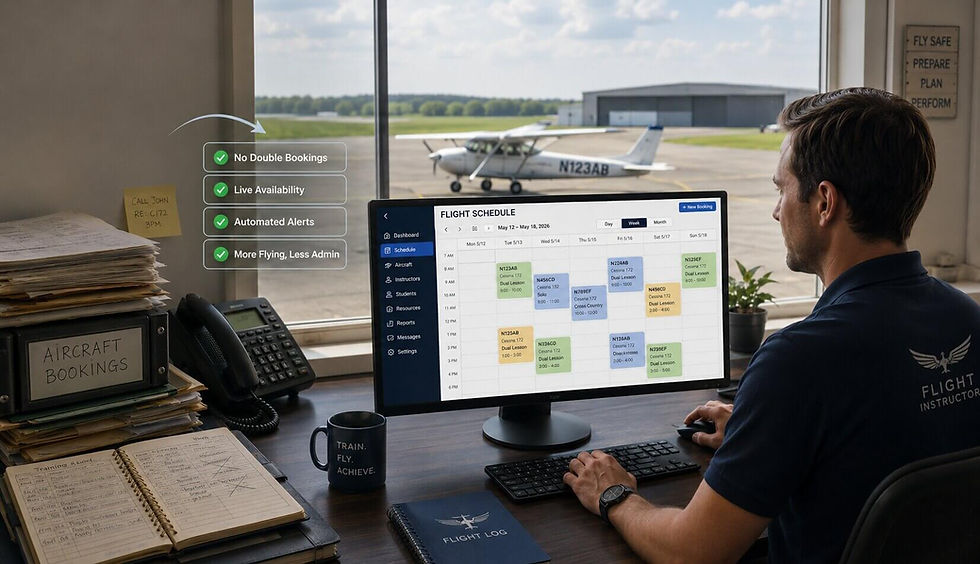
Why Flying Clubs Outgrow Spreadsheets and Need Flying Club Scheduling Software


Two partners both circled Saturday morning weeks ago. One penciled it onto the shared spreadsheet. The other was sure he had called it in the group text. Saturday comes, both families are loaded into the car, and both show up at the hangar to fly the same airplane at the same time. Now two friends are standing on the ramp working out who flies and who drives home. Nobody did anything wrong. The system did.
Flying club scheduling software helps clubs replace spreadsheets with an easier way to manage aircraft bookings, member schedules, and availability.
If you share an airplane, you have either lived a version of this or you are headed for it. The casual way most partnerships and clubs schedule works right up until the day it does not, and that day usually arrives with an audience.
The shared-aircraft problem nobody plans for
When a few people buy into an airplane together, or a dozen pilots join a club, scheduling looks like the easy part. You set up a shared calendar or a group text, everyone is reasonable, and for the first few months it runs fine.
It degrades slowly, which is what makes it sneaky. One missed entry, one person who books in their head instead of on the calendar, one popular Saturday that three people want, and the cracks start to show. By the time scheduling becomes a real source of friction, it has usually already cost someone a flight and cost the group a little goodwill.
How Flying Club Scheduling Software Solves These Problems
The failure points are nearly the same across every club and partnership:
The double-booking. Two people grab the same airplane for the same window, and nobody finds out until they are both at the hangar. A shared file anyone can overwrite makes this a matter of when, not if.
No live view. You cannot see at a glance what is open, so you send a text and wait for an answer, then send another. Booking a flight should not require a conversation.
No backup when a slot frees up. The good Saturday is taken, then the person who booked it cancels Friday night, and the plane sits unused because nobody knew it opened.
No record. When someone feels another member is hogging the airplane or canceling at the last minute, there is no history to look at, only impressions and hard feelings.
The one-person bottleneck. In a lot of clubs, one member quietly becomes the human scheduler. When they travel or step down, the whole thing wobbles.
None of these are disasters on their own. Together they turn the simple act of going flying into a low-grade negotiation, and over time that is what wears a club or a partnership down.
What changes when the scheduling is done right
Move the schedule into a tool built for shared aircraft and most of this just goes away.
This is the job PilotSchedule was built for, and for a small club or partnership it comes down to a few things that matter:
One live calendar everyone sees. Availability is visible to every member in real time, so conflicts are prevented instead of discovered at the hangar.
Backup reservations. A member can claim the next spot in line, and PilotSchedule emails them the moment it becomes their reservation. That freed-up Saturday goes to the next pilot instead of going to waste.
Fair access you can see. When everyone looks at the same calendar, fairness stops being a feeling and becomes something visible. The arguments about who flies when get a lot quieter.
Block the times the airplane is not available. Down for an oil change or an annual? Block it once and every member sees it. No more bookings against a plane that is in the shop.
A record of who booked what. If a question ever comes up, the history is right there, which tends to keep everyone honest and friendly.
It is not just airplanes
Most shared operations have more than one thing worth keeping on a calendar: a tow tractor, a hangar bay, a simulator, a second airplane, even an instructor. PilotSchedule lets you add these as custom resources on the same schedule as the aircraft, so the whole operation lives in one place instead of three.
Let members book for themselves
The biggest relief for most clubs is getting out of the middle. With self-service booking, every member reserves their own time against the live calendar, so no one person has to run the schedule. When plans do change, you can reach every pilot and instructor at once with a mass email instead of hoping the group text gets read.
What it costs for a small group
It helps to know how this software is usually priced, because clubs and partnerships sit in a specific corner of the market.
Most club-focused tools meter by the airplane and bundle in billing. Flight Circle publishes $10 per aircraft per month and includes Hobbs-based invoicing and dues. Schedule Master runs roughly $8 to $12 per resource per month with billing built in. Others in this group, like Pilot Partner and Coflyt, work the same way. If your club wants member billing, autopay, and usage invoicing handled inside the same system, these are worth a look, and the price is reasonable. (Published rates as of mid-2026, and they change.)
PilotSchedule takes a simpler path on purpose. Pricing is flat and published: the Solo plan is $19 a month and fits a partnership sharing a plane or two, and the Basic plan is $49.99 a month for a small club with up to five resources. There is no setup fee, no contract, and a free account to start. What you will not find is a billing engine, because PilotSchedule does scheduling and does it simply, which is exactly why it stays cheap and easy to learn.
So the honest way to choose is this. If you want billing and dues automated inside the same tool, go with one of the per-aircraft platforms that bundle it. If your real problem is the scheduling chaos, and you handle money your own way or your group is small enough that money is not the issue, PilotSchedule is the simpler and friendlier fit. It is at its best for partnerships and small clubs that just want sharing an airplane to stop being complicated.
Built by a pilot, and still here since 2003
It is worth knowing who is behind the calendar your whole group will depend on. PilotSchedule was created by a pilot and has been running reservations for clubs and partnerships since 2003. Two decades of doing one job well is a big part of why a small group can hand it the schedule and stop worrying about it.
Set up in an afternoon
Getting going is short. Start a free account, add your airplane (or airplanes) and any resources, invite your members, and start booking. Everyone sees the same live calendar from a phone or a laptop, and the spreadsheet can finally retire. If your group can read a calendar, your group can use it.
Frequently asked questions
Do flying clubs really need scheduling software, or is a spreadsheet enough?
A spreadsheet is fine for the first few months and for very small groups. Once more than a couple of people share an airplane, you start hitting double-bookings, last-minute cancellations nobody sees, and disputes with no history. A purpose-built calendar removes those for a low monthly cost.
What is the difference between flying club software and a scheduling tool?
Full club-management platforms bundle scheduling with billing, dues, and maintenance tracking. A scheduling tool like PilotSchedule focuses on the calendar: shared availability, backup reservations, and fair access. It is simpler and cheaper, and it suits groups that do not need billing built in.
Does PilotSchedule handle member billing and dues?
No, and that is by design. It keeps to scheduling so it stays simple and affordable. Many clubs handle dues separately and just want the calendar fixed. If you need invoicing and autopay inside the same system, a per-aircraft platform that bundles billing will fit better.
How much does it cost for a small club or partnership?
PilotSchedule is flat and published: $19 a month for a partnership on the Solo plan, and $49.99 a month for a small club on the Basic plan, with no contract and a free account to start.
Can every member book their own time?
Yes. Members see the live calendar and reserve their own slots, and you can reach everyone at once by mass email when plans change. No single person has to run the schedule.
The bottom line
Sharing an airplane should be the fun part, not a standing negotiation. For a flying club or a partnership, the fix is rarely a heavy management platform. It is a simple shared calendar that prevents the double-bookings, surfaces the freed-up slots, and lets everyone see the same fair picture, without a billing system you did not ask for.
PilotSchedule has done exactly that for clubs and partnerships since 2003: straightforward scheduling, flat and published pricing, and no contract. If your group is ready to retire the spreadsheet, you can have everyone booking the same afternoon.
See the plans on our pricing page, or create your free club and start scheduling in minutes.
PilotSchedule has helped flight schools, flying clubs, and independent instructors keep their aircraft and CFIs organized since 2003, whichever training path they run.