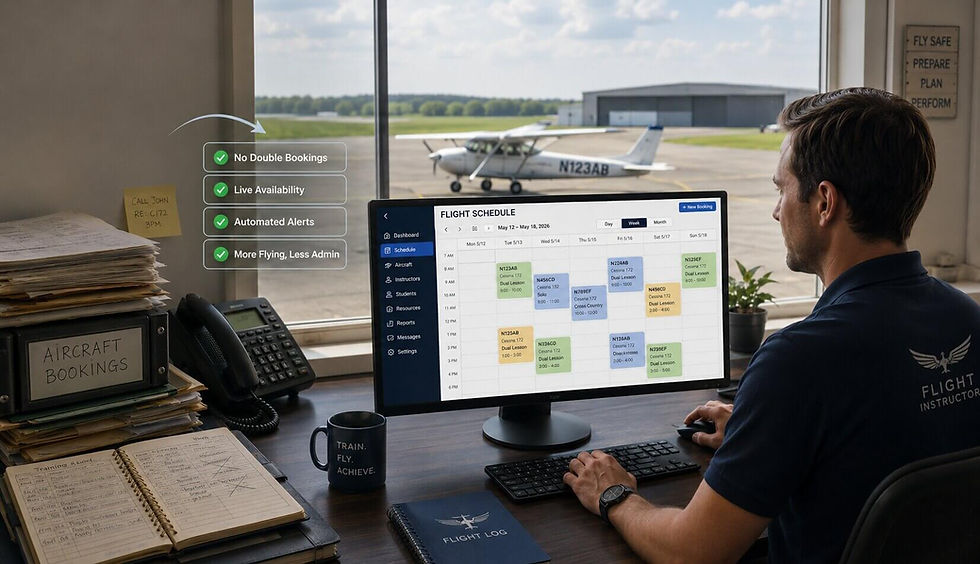
The Part-Time CFI's Guide to Filling Your Schedule (Without Living in Your Text Messages)


Ask a part-time CFI what they charge and you get a quick answer. Ask what they actually earned last month and the answer gets complicated, because between the day job, the family calendar, three students, and a borrowed airplane, the limiting factor was never the rate. It was the schedule.
The market data backs this up. Independent CFIs typically charge $40 to $70 an hour mid-career, and $70 to $100 or more with experience, with specialty instruction (multi-engine, tailwheel, seaplane) commanding $100 to $200. But the same analysis makes the sharper point: utilization beats rate. An instructor charging a modest $45 an hour who consistently fills 110 hours a month out-earns plenty of higher-priced CFIs who fly half that. For a part-timer the numbers are smaller but the principle is identical. Ten bookable hours a week at $60 is roughly $31,000 a year of side income, and every one of those hours that goes unfilled, gets canceled without a replacement, or dies in a text thread comes straight out of that total.
So this is not an article about charging more. It is about the four ways part-time CFIs quietly lose billable hours, and how to stop losing them.
Killer 1: Scheduling by text message
Count the messages it takes to book one lesson the manual way. "Are you free Saturday?" "Morning or afternoon?" "Does 2 work?" "Actually can we do Sunday?" Six or eight texts, spread over a day or two, multiplied by every student, every week. That is hours of unpaid dispatcher work stapled to your teaching, and it has a subtler cost: latency. A student with a free Saturday texts you Tuesday night. You are at your day job, or at dinner, and by the time you reply, their weekend has filled up with something else.
When your availability is visible online and students book themselves, the Tuesday-night impulse becomes a Tuesday-night reservation. You find out about lessons the way you should: as a confirmation, not a negotiation.
Killer 2: The cancellation that stays empty
Part-time schedules are brittle. You have, say, six teachable slots a week, so one late cancellation is a sixth of your flying income gone, and by text there is no realistic way to refill it. You are not going to message every student at 9 pm hoping someone bites.
On a shared live calendar, a canceled slot reappears for every student the moment it opens, and a backup reservation can hand it automatically to the student who wanted that time in the first place, with an email telling them it is now theirs. Your most motivated student, the one pushing for a checkride date, becomes your automatic cancellation insurance.
Killer 3: Availability nobody can see
Here is the quiet one. Students do not book hours they do not know exist. If your Thursday evenings are open but no student knows it, those hours simply do not exist in your business. The manual fix is broadcasting your openings by group text, which nobody reads twice.
The durable fix is publishing your availability: your open slots visible on a calendar, and everything else blocked. Students plan their training around what they can see, further ahead, and your odd pockets of free time start earning instead of evaporating.
Killer 4: The two-calendar problem
An independent CFI rarely schedules just themselves. There is an airplane in the equation: the student's own plane, a club aircraft, a rented 152. A lesson only happens when you and the airplane are free at the same time, and coordinating that by text means every booking is two negotiations glued together.
Put the aircraft on the same calendar as your availability and one reservation books the pair. Teach in three different airplanes for three different students? Each one is a resource, each with its own availability and maintenance blocks, and the calendar refuses the impossible combinations you would otherwise discover in a hangar doorway.
The consistency dividend
One more scheduling effect is worth money to you and your students at the same time. Flight training rewards frequency: a student who flies two or three times a week retains more between lessons, repeats less, and typically finishes in fewer total hours than one who flies twice a month. Every instructor has watched the sporadic student spend the first half of each lesson re-learning the last one.
Consistency is not a motivation problem. It is a scheduling problem. When booking a lesson takes a text negotiation, students drift to "whenever works," and whenever averages out to not often. When they can see your calendar and hold a standing weekly slot, the default flips: training happens unless something cancels it, instead of happening only when two text threads align.
A standing Tuesday-and-Saturday student is also the best thing that can happen to a part-time CFI's income: predictable hours, less rebooking overhead, and a student who reaches the checkride ahead of schedule and tells their friends who got them there.
Part-Time CFI Scheduling in Practice
This is the job flight instructor scheduling software exists to do, and PilotSchedule keeps it deliberately simple. You set up one calendar with yourself and the aircraft you teach in. You block the day job, the family time, and anything else that is off-limits, once for the recurring stuff. Students see only the openings you actually offer, book themselves from any phone, and the calendar will not take a double-booking. Cancellations reappear instantly, backup reservations refill them by email, and a schedule log keeps the history straight if a question ever comes up. When something changes for everyone, weather, an airplane down for its annual, one mass email reaches every student at once.
Two things are worth saying plainly. First, the blocking is the feature that makes part-time instruction sustainable: the calendar defends your boundaries so you do not have to say no by text, one apologetic message at a time. Second, PilotSchedule is scheduling only. There is no invoicing, no payment processing, no billing engine, on purpose. However you handle money with your students now (Venmo, cash, a monthly tally) keeps working; the software just makes sure there are more flown lessons to bill for.
The Solo plan is $19 a month flat, with no per-student fees, no contract, and no setup fee. At a $60 lesson rate, a single recovered hour pays for three months of it. It was built by a pilot, and independent instructors have run their books on it since 2003.
A setup that takes one evening
Create a free account and add yourself as the instructor.
Add the aircraft you teach in (a student's plane, a club plane, a rental) as resources.
Block your recurring off-limits time: the day job, standing family commitments, the annual on the club plane.
Invite your students and turn on self-booking.
Tell them the one new rule: if it is not on the calendar, it is not booked.
From that point, the calendar does the dispatching, and your text messages go back to being about flying.
Frequently asked questions
How do students book me without calling or texting?
They open the live calendar, see your actual openings (with the airplane's availability already accounted for), and reserve a slot from their phone. You get the booking as a notification instead of a negotiation, and the calendar blocks double-bookings automatically.
I teach in my students' own airplanes. Does that still work?
Yes, and it is where the two-calendar fix earns its keep. Add each airplane as a resource, and a lesson reserves you and the airplane together. Maintenance blocks keep anyone from booking a plane that is down, whoever owns it.
How do I keep my day job and family time protected?
Block them, including as recurring blocks for the standing commitments. Students never see blocked time as available, so your boundaries enforce themselves and you stop being the bad guy by text.
Does it handle payments or invoicing?
No, on purpose. PilotSchedule does scheduling only, which keeps it at $19 a month with no per-student fees. Keep collecting payment however works for you and your students; the calendar's job is making sure more lessons actually happen.
Is it worth it for just two or three students?
That is exactly who it is for. The fewer teachable hours you have, the more each lost one costs you, and a part-timer with six weekly slots feels one dead cancellation more than a full-time academy feels ten. One saved lesson covers a season of the subscription.
The bottom line
A part-time CFI's income is set less by the hourly rate than by how many teachable hours survive contact with real life. Texting loses hours to latency, cancellations, invisible availability, and airplane logistics. A published, self-booking calendar recovers them, and defends the hours that were never for sale in the first place.
Your rate is fine. Your schedule is the raise. Create your free account, block what is off-limits, add your airplanes and students, and let the calendar fill the hours you actually want to fly.